The Mammoth Book of Celtic Myths and Legends by Peter Berresford Ellis
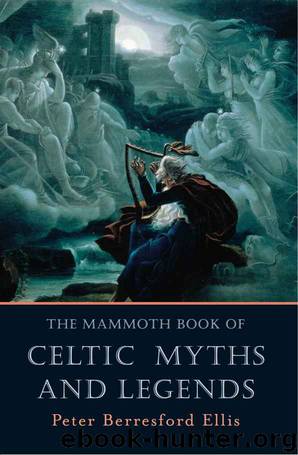
Author:Peter Berresford Ellis [Ellis, Peter Berresford]
Language: eng
Format: epub, azw3
ISBN: 9781780333632
Publisher: Little, Brown Book Group
Published: 2011-09-01T06:00:00+00:00
Wales (Cymru)
Wales: Preface
This selection of Welsh myths and legends starts with the story of Bran and Branwen, the children of Llyr. This appears in the Second Branch of the Pedair Cainc y Mabinogi (The Four Branches of the Mabinogi). The term Mabinogi originally meant a “tale of youth” and has since become simply “a tale”. The stories of the Mabinogi were first made known to the English-speaking world in translation by Lady Charlotte Guest (1812–1895) as Mabinogion in three volumes in 1846. Her translations have been open to question for, although she learnt Welsh, she relied on the help of John Jones and Thomas Price in that field, and her task was merely to render the stories into good English. She was actually born in Uffington in Lincolnshire and became interested in Welsh matters after her marriage to Sir Josiah John Guest (1785–1852) of Dowlais, Glamorgan.
Both the Mabinogi and Lady Guest’s work have, of course, been the subject of countless scholastic studies. The texts come from the Llyfr Gwyn Rhydderch (The White Book of Rhydderch, c. 1300–1325) and Llyfr Coch Hergest (The Red Book of Hergest, c. 1375–1425) together with the fragmentary texts in the Peniarth Manuscript 6, (c. 1225–35). Some scholars believe that the texts were copies from an earlier manuscript source, possibly set down about 1060, according to the scholar Sir Ifor Williams. Professor Proinsias Mac Cana and Dr Patrick Sims-Williams have argued about this dating.
A recent study, Medieval Welsh Literature by Andrew Breeze (Four Courts Press, Dublin, 1997), argues that four of the eleven tales which comprise the Mabinogi, “Pwyll, Prince of Dyfed”, “Branwen, Daughter of Llyr”, “Manawydan, son of Llyr” and “Math, son of Mathonwy” were all apparently written between 1120 and 1136 by an author identified as Gwenllian (d. 1136) of Gwynedd and Dyfed. Gwenllian’s father was Gruffudd ap Cynan (1055–1137), king of Gwynedd, and her husband was a prince of Dyfed. However, as intriguing as Dr Breeze’s arguments are, the evidence is admittedly circumstantial. Certainly the themes and motifs of the stories are older and it is obvious that, even if Gwenllian is the author, she was merely retelling the stories.
If Gwenllian was the author of these stories, it does make a fitting image of a rather intriguing woman. When the Anglo-Normans attacked her husband’s territory, while her husband Gruffydd ap Rhys was away, Gwenllian raised an army and led a counter-attack which drove the Anglo-Normans back to Cydwedi (Kidwelly) castle. Under the command of Maurice of London, the Anglo-Normans fortified themselves in the castle. Gwenllian led an attack on the castle but her men were driven off. She was killed fighting a rearguard action at the fort of Maes Gwenllian (Gwenllian’s Field) in 1136/37. She had managed to drive off the initial Anglo-Norman invasion and gave her husband time to prepare his forces.
Branwen uerch Llyr (Branwen, daughter of Llyr), which she is said to have retold, is the main basis of our first tale, which is found in the Second Branch. By the
Download
The Mammoth Book of Celtic Myths and Legends by Peter Berresford Ellis.azw3
This site does not store any files on its server. We only index and link to content provided by other sites. Please contact the content providers to delete copyright contents if any and email us, we'll remove relevant links or contents immediately.
| Anthropology | Archaeology |
| Philosophy | Politics & Government |
| Social Sciences | Sociology |
| Women's Studies |
Cecilia; Or, Memoirs of an Heiress — Volume 1 by Fanny Burney(32558)
The Great Music City by Andrea Baker(32018)
Cecilia; Or, Memoirs of an Heiress — Volume 2 by Fanny Burney(31956)
Cecilia; Or, Memoirs of an Heiress — Volume 3 by Fanny Burney(31941)
We're Going to Need More Wine by Gabrielle Union(19046)
All the Missing Girls by Megan Miranda(16023)
Pimp by Iceberg Slim(14506)
For the Love of Europe by Rick Steves(14121)
Bombshells: Glamour Girls of a Lifetime by Sullivan Steve(14073)
Talking to Strangers by Malcolm Gladwell(13370)
Norse Mythology by Gaiman Neil(13363)
Fifty Shades Freed by E L James(13239)
Mindhunter: Inside the FBI's Elite Serial Crime Unit by John E. Douglas & Mark Olshaker(9339)
Crazy Rich Asians by Kevin Kwan(9291)
The Lost Art of Listening by Michael P. Nichols(7506)
Enlightenment Now: The Case for Reason, Science, Humanism, and Progress by Steven Pinker(7311)
The Four Agreements by Don Miguel Ruiz(6765)
Bad Blood by John Carreyrou(6621)
Weapons of Math Destruction by Cathy O'Neil(6279)
